Catchment versus Wells
I moved to Big Island about 8 year ago. One of my first decisions was whether to install a catchment system or a well. I grew up on a farm, but for most of my life, I have been a city boy. I knew nothing about water catchment or wells.
I did find the definitive guide for catchment systems in Hawaii. It was written by Patricia S. H. Macomber at the University of Hawaii. The title is “Guidelines on Rainwater Catchment Systems for Hawaii”. This is the bible for understanding and managing a catchment system. It is for sale in several places, but you can get a copy for free and this website;
https://www.ctahr.hawaii.edu/hawaiirain/guidelines.html
If you are planning to install a catchment system, this is a “must-read”.
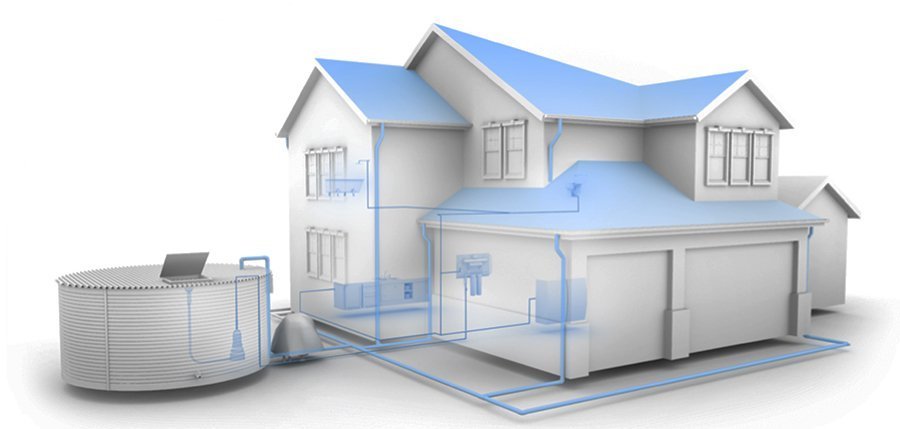
Catchment systems are fairly simple. You need a surface to collect rainwater, usually the roof of the house. It should be a painted metal roof in good condition. Make sure there are no trees or shrubs that would be dropping leaves and branches onto your roof
Do not use an asphalt roof for catchment. I had a listing where the catchment system was on an asphalt roof. The bottom of the holding tank was covered with a black chemical sludge, really disgusting, and probably poisonous. They did not drink or use the water for cooking. It was only used for washing things and taking showers, but still, not recommended.
The gutters and downspouts are connected by PVC pipe to each other and the holding tank. It all works on gravity, so the top of the catchment tank has to be lower than the gutters.
The next element of the system is the holding tank. Mine is made of corrugated steel panels, bolted together, but there are many different options to choose from. People also use the above ground swimming pools for holding tanks, but that is not recommended. They don’t have the structural strength
In addition to the metal tank, I had to buy a liner. Again there are several options for tank liners, but I would recommend get a food grade line. One important modification that I have made is panty hose. The knee high ones are best. I have to say, I get some funny looks when I am buying panty hose for my catchment tank. Despite my best effort, there is always some debris that ends up on the roof, and in the system. I fasten a panty hose to the intake pipe, using a hose clamp. It catches a lot of debris, and is changed monthly, when I do my system maintenance.
Last thing for the tank is the feed line going to the pump. It should have a back-flow preventer to stop water from being pushed back into the tank by the pump. I would also recommend the floating intake. The end is flexible, and the end of the hose is connected to a float which keeps the feed line near the surface of the water. This is important. The panty hose does allow small particles to get into the tank. These particles tend to settle to the bottom of the tank. If your feed line ends near the bottom of the tank, you are probably picking up a lot of that debris. The water is much cleaner near the surface.
Last item for the tank is the overflow preventer. It stops the water from overfilling the tank and flowing over the side. That would not be good for the integrity of the tank. It is an S-shaped piece of PVC pipe. When the water exceeds a certain level, gravity forces the water through the overflow pipe and is directed away from the tank
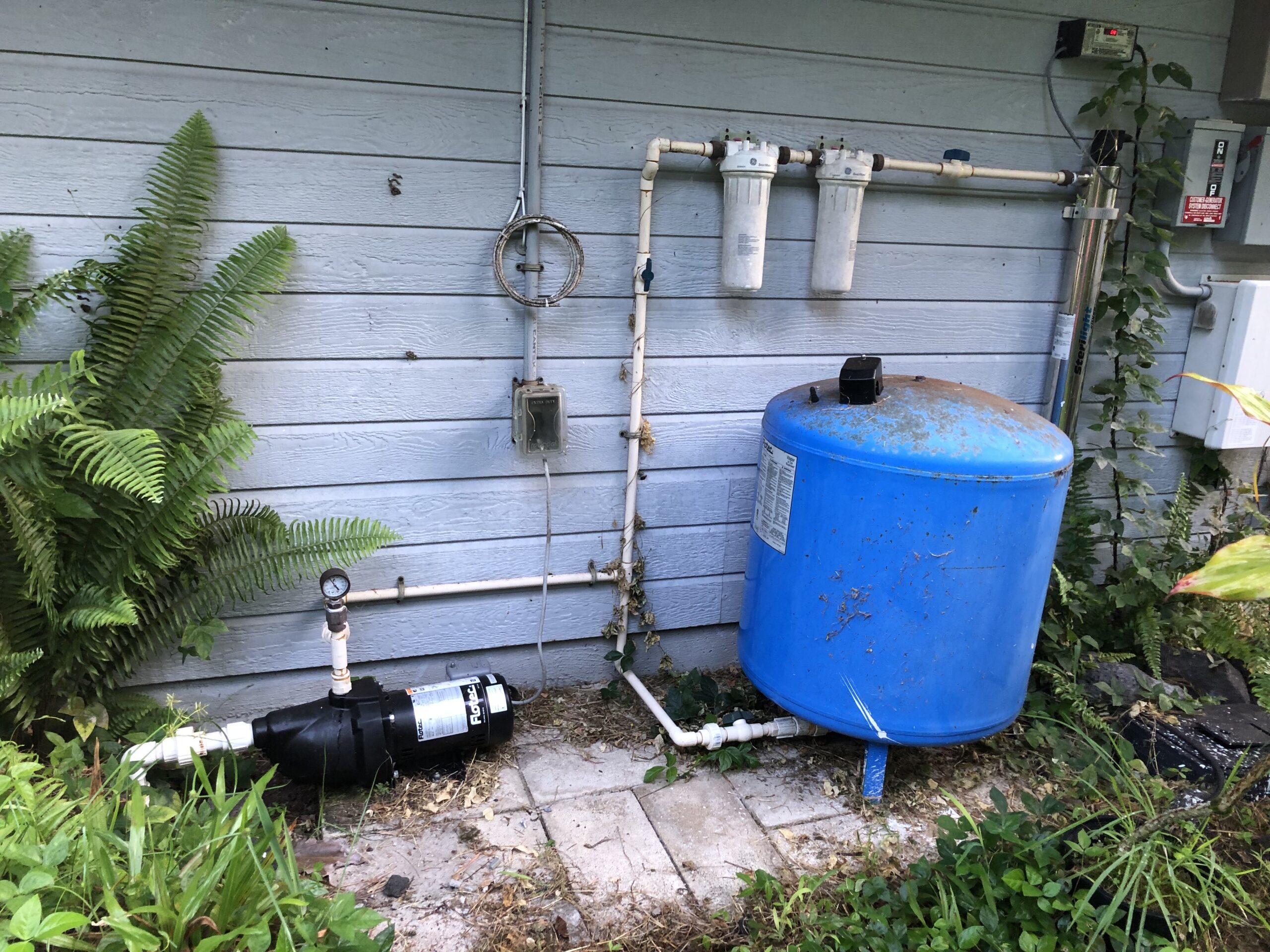
Now we get to the pump. I have a ¾ horsepower shallow well pump that works very well. There are a lot of options, though. Off-grid systems use very small direct current pumps.
Next is the filters, and UV light. I have seen some systems with three filters, but I use just two. I have a 30 micron filter and a 5 micron filter. The 30 micron filter should come first. It catches the larger particles, and lets the smaller ones through. After the filters, the water passes through a ultraviolet light, which kills any microorganisms that made it through the filters
The last element is the pressure tank. This is basically a canister with a sturdy balloon filled with air inside. This is what pressurizes your system
A lot of local people do not drink the catchment water. However, if properly filtered and managed, it can provide potable water. I have been drinking catchment water for years with no ill effect.
Managed is the key word. Every month, I inspect the entire system. I also add clorine to the catchment tank. I have a 10,000 gallon tank. Each month, I add 8 cups of bleach to the tank. If it is not full, I prorate that amount. 8 cups seems like a lot, but I cannot taste or smell the clorine after it has been added to the water. I also add 8 cups of baking soda to the water. Because of our volcanos, the rain tends to be mildly acidic, which is not good for copper pipes. Baking soda reduces the acidity.
Changing the filters is another story. It really depends on how hard they are working. I was changing the filters quarterly, but lately, I have been having to change them every two months. Some people change them every month. One good indicator for changing the filters is water pressure. If you notice that the water pressure in the house seems to be failing, it a good bet that the filters needs to be changed.
The final maintenance item is the UV light. That needs to be changed annually. The UV light that I purchased has a digital display that counts down the days and starts beeping when the count gets to zero. You don’t replace the entire unit, just the light bulb, a long glass cylinder.
Wells are a different thing. When I was deciding between well or catchment, price was the deciding factor. The catchment system ended up costing about $5,000 for a 10,000 gallon system. A well would have cost $3,000 for the equipment, and $100 per foot for drilling the well. How far they have to drill depends on your elevation above sea level. I am at about 400 feet above sea level, and the contractor estimated I would have to drill down 150 ft, which would have cost $15,000. So, instead of a holding tank you have a hole drilled down to the water table. Other than that, the systems are going to be pretty much the same.
Choosing well or catchment depends on more than price. Catchment is dependent on the level of rain, which can very considerably, depending on location. I live in Hawaiian Paradise Park on 28th Avenue. We get lots of rain. My tank is generally overflowing. However, as you get closer to the ocean and lower elevations, the amount of rainfall drops significantly. From 10th Avenue to the ocean, it is predominantly wells
Well, that is my article. I hope it provided some useful information about catchment and wells on Big Island. As I said above, though, the best source of information about catchment systems, is the guideline published by Patricia S. H. Macomber, “Guidelines on Rainwater Catchment Systems for Hawaii.
Aloha